


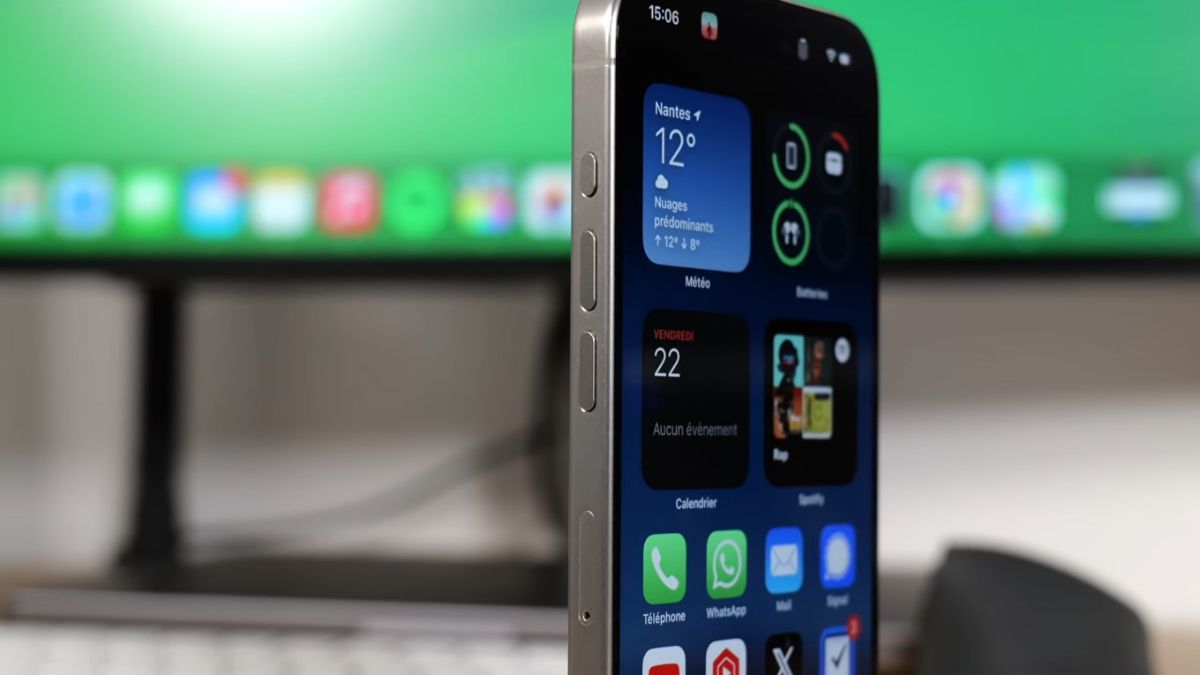
With the iPhone 15 marketed in the United States, Apple has confirmed a direction initiated several years earlier: the complete disappearance of the physical SIM card. On this model, no tray is present, no removable chip can be inserted. All mobile network management now relies on the integrated eSIM. This choice is neither improvised nor solely guided by a desire for simplification. It is based on a combination of hardware constraints, the maturity of American networks, and specific industrial objectives.
This removal raises many questions, particularly about why Apple has limited this change to the United States while retaining the physical SIM card on the iPhone 15 sold in other regions. Behind this difference in treatment lie distinct technical and economic realities.
Apple’s decision is primarily based on the state of the American telecommunications market. In the United States, the eSIM has been widely deployed for several years. Major operators have invested heavily in remote activation systems capable of managing millions of lines without physical support.
According to data published by the GSMA, more than 92% of American mobile subscriptions can now be activated without a traditional SIM card. This proportion is significantly higher than that observed in Europe or Asia, where some operators still heavily rely on physical supports for line opening or portability.
Apple has therefore chosen a territory where the removal of the physical SIM does not cause a massive disruption for the end user. The majority of customers can activate their iPhone 15 in a few minutes, directly from the device, without visiting a store or postal delivery.
Inside a smartphone, every millimeter counts. The space dedicated to the SIM card is not limited to a simple tray visible from the outside. It involves a complete structure integrated into the chassis, an ejection mechanism, moisture protection, and precise routing to the motherboard.
By removing this assembly, Apple frees up internal volume that can be used for other components. On the iPhone 15, this recovered space has been redistributed to several sensitive areas, particularly around the battery and thermal modules.
Teardown analyses show that the disappearance of the physical SIM allows for the recovery of about 30 to 40 cubic millimeters. Relative to the entire phone, this represents nearly 1% of the total internal volume, a valuable margin in a device where every component is already optimized to the extreme.
The presence of a SIM tray has historically been one of the weak points in terms of waterproofing. Even with seals, this opening remains a sensitive area against water, dust, and microparticles.
By completely removing this opening, Apple simplifies the chassis design and reduces the number of potential penetration points. On the American iPhone 15, the side chassis is now entirely closed, which improves resistance to infiltration over the long term.
Laboratory tests show that devices without side openings retain their waterproof properties longer, especially after several years of exposure to humidity. This improvement is not always visible on the technical sheet, but it plays a real role in the phone’s durability.
The eSIM offers Apple much finer control over the activation process. Unlike a physical SIM card, which depends on logistical stock, the eSIM allows for entirely software-based management of operator profiles.
In the United States, this approach facilitates immediate commissioning upon purchase. According to Apple, more than 70% of American iPhone 15s are activated the same day they are taken out of the box, without human interaction with an operator.
This fluidity reduces friction, but it also allows Apple to harmonize the user experience, regardless of the chosen operator. The removal of the physical SIM eliminates compatibility issues related to card formats, incorrect cuts, or defective cards.
If the removal of the physical SIM card was so advantageous, why didn’t Apple apply it everywhere? The answer lies in infrastructure disparities.
In many countries, the eSIM is still partially supported. Some operators still require a store visit, others limit the number of possible transfers, and some markets impose specific regulatory constraints.
In Europe, for example, only about 60% of operators offer fully dematerialized eSIM activation. In Asia, this rate can drop below 50% in certain areas. Apple has therefore chosen a progressive approach, reserving the complete removal of the physical SIM for regions where it does not penalize the user.