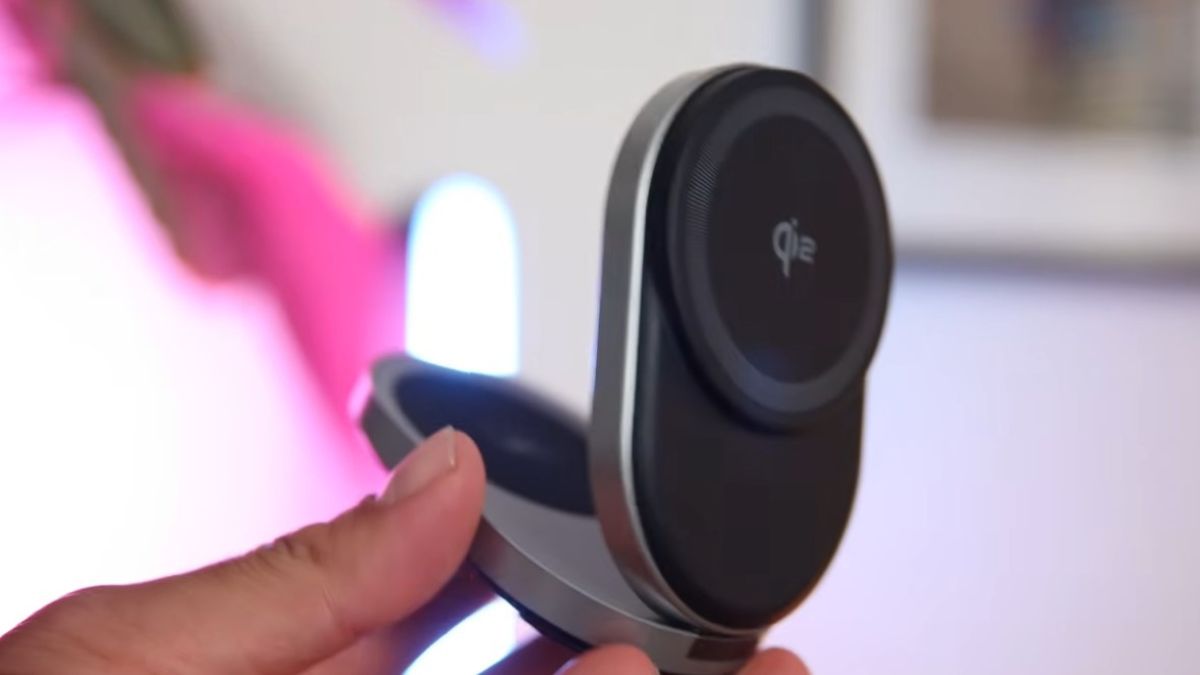
The Qi2 standard marks an important step in wireless charging. The goal is to unify magnetic systems between manufacturers, improve alignment between phone and charger, and offer more stable speeds. In theory, Qi2 should address the classic issues of wireless charging: energy loss, excessive heating, and uncertain positioning.
But one question keeps coming up:
Which smartphones truly benefit from Qi2 today, and which only partially exploit it?
Contrary to what one might think, compatibility is not always obvious. Some models are certified, others are only “Qi2 ready” via accessories, and still others only support traditional Qi with reduced performance.
Few manufacturers have fully integrated Qi2 so far. Apple has taken the lead, while the Android side is gradually progressing, model by model.
Qi2 certification imposes specific conditions: integrated magnets, calibration between the magnetic ring and the charging block, enhanced thermal management, and communication between the smartphone and the charging base.
Here is an overview based on manufacturers’ data and available certifications.
Apple adopted magnetic charging as early as 2020. As a result:
all iPhones from the iPhone 12 are considered natively Qi2 compatible.
Confirmed list:
– iPhone 12, 12 mini, 12 Pro, 12 Pro Max
– iPhone 13 (entire range)
– iPhone 14 (entire range)
– iPhone 15 and 15 Pro (officially Qi2 compatible thanks to internal magnets already aligned with the standard)
Why is Apple already aligned?
Because Qi2 incorporates a magnetic system very similar to MagSafe. The transition was therefore natural: the magnets, layout, and thermal measures already met the prerequisites.
According to the Wireless Power Consortium, these models already meet Qi2 criteria thanks to their internal architecture initially designed for MagSafe.
The Android situation is evolving rapidly. Several manufacturers have announced their first natively compatible models.
The most recent examples include:
– certain models announced for 2024–2025 from Xiaomi, Honor, Nothing, and OnePlus, directly integrating a Qi2-calibrated magnetic module
– some devices sold in China and India whose global versions are gradually adopting Qi2
However, unlike the iPhone, the majority of current Android phones do not integrate internal magnets, which limits the full use of the standard.
This is where the next section becomes important.
Some manufacturers have chosen a different approach: offering “Qi2 ready” devices, meaning they can use Qi2 provided a compatible magnetic accessory is added.
The most notable recent example: the Samsung Galaxy S25
Samsung has confirmed that the Galaxy S25 series can use all Qi2 features, but only with an official magnetic case.
Without this case, the phone remains limited to classic Qi charging.
This means that the internal hardware is compatible, but the absence of an integrated magnetic ring prevents the perfect positioning essential for the Qi2 standard.
Other brands follow the same logic:
– Oppo
– Realme
– Vivo
This approach avoids placing magnets in the phone but still allows access to Qi2 via an accessory.
It is therefore a conditional compatibility, not native.
Many models released before 2023 remain compatible with wireless charging, but only via standard Qi.
This means several things:
– No magnetic alignment.
– Variable power depending on positioning.
– Slower and sometimes unstable charging.
– More frequent heating.
Public tests show that a classic Qi phone can lose between 20 and 35% of effective power if the placement is not optimal.
Qi2 significantly reduces this loss thanks to the calibrated magnetic ring.
These models will therefore never fully benefit from Qi2, even with a magnetic case, because the central magnet must be integrated on the phone side to activate Qi2 communication.
To avoid confusion, here is a reliable verification method.
1 Search in the Wireless Power Consortium database
This is the only source that officially publishes Qi2 certifications.
If the model does not appear there, it is not certified.
2 Check the manufacturer’s data sheet
Some manufacturers now clearly mention “Qi2 certified” or “Qi2 compatible with magnetic case.”
3 Look for the presence of an integrated magnetic ring
If your smartphone has an internal magnetic ring (as is the case with iPhones since 2020), it is highly likely to be Qi2 compatible.
4 Examine independent tests
Some smartphones charge on Qi2 but at reduced power, indicating limited compatibility.

'/%3E%3C/svg%3E)

'/%3E%3Cpath%20fill='%23b2b2b2'%20d='M241%20382q0%2016%2017%2026%2017%2011%2042%2011t42-11q16-11%2017-26V269H241'/%3E%3Cpath%20fill='%239f7e00'%20d='M241%20379q0%2014%208%2023%209%209%2021%209%2014%200%2021-9%209-9%209-23V269h-59'/%3E%3Cpath%20d='M241%20339v-70h59v110q0%2014-9%2023l-6%205v-68h-15v72q-8%200-14-4v-68zm59%2040c0%2022%2015%2032%2029%2032%2021%200%2030-18%2030-32v-40h-59'/%3E%3Cpath%20fill='%239f7e00'%20d='M266%20277v5h2v12h-3v-5h2v-5h-9v5h2v5h-4v9h3v18h-5v10h34v-10h-5v-18h3v-9h-4v-5h2v-5h-9v5h2v5h-3v-12h2v-5zm42%20101q0%2010%206%2017%206%206%2015%207%2010-1%2016-7%206-7%206-17v-29h-43'/%3E%3Ccircle%20fill='%230044ad'%20cx='329.5'%20cy='372'%20r='6'/%3E%3Cellipse%20fill='%230044ad'%20cx='300'%20cy='340'%20rx='16'%20ry='21'/%3E%3C/svg%3E)

'/%3E%3C/g%3E%3Cuse%20href='%23c'%20transform='matrix(-1%200%200%201%20720%200)'/%3E%3C/svg%3E)
