


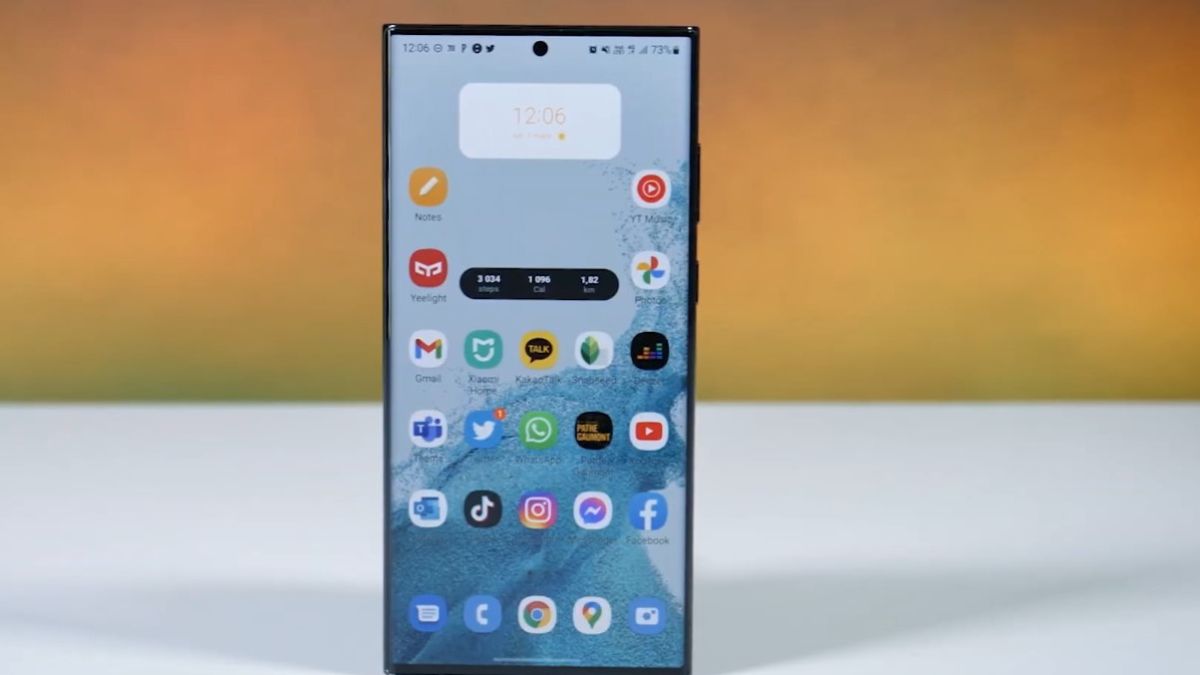
The Samsung Galaxy S22 Ultra is one of the most talked-about smartphones of its generation, particularly for its AMOLED LTPO screen capable of varying its frequency between 1 and 120 Hz. On paper, this technology promises adaptable display for every situation and better energy consumption management. However, many users and observers quickly raised questions about how this refresh rate is actually used. Between theoretical promises and observed behavior, the real functioning of the 1-120 Hz of the S22 Ultra deserves careful reading, supported by figures.
The Galaxy S22 Ultra is equipped with a 6.8-inch AMOLED LTPO screen with a QHD+ resolution. Samsung announces an automatic frequency variation between 1 Hz and 120 Hz, depending on the displayed content. The idea is simple: reduce the frequency during static content like an image or text, then increase it during animations or scrolling.
Technically, LTPO theoretically allows the frequency to adapt almost instantly. At 1 Hz, the screen refreshes only once per second, which greatly reduces consumption. At 120 Hz, the display becomes very responsive during scrolling or gaming. This extremely wide range is the central argument highlighted by Samsung at launch.
When observing the behavior of the Galaxy S22 Ultra using diagnostic tools, the findings are more nuanced. In many static situations, the frequency does not systematically drop to 1 Hz but rather stabilizes around 24 Hz, 48 Hz, or 60 Hz.
Tests conducted by several independent laboratories show that the 1 Hz threshold is mainly reached in very specific cases, such as displaying a completely frozen image or the Always On Display screen. When reading text or an immobile web page, the frequency often remains much higher than expected.
This difference between the announced range and the actually used range raises questions about the concrete exploitation of LTPO in real use.
The variation in refresh rate depends on many internal parameters. Even when the screen seems static, micro-animations persist: active cursor, system clock, notifications, or even brightness sensors triggering slight updates.
On the Galaxy S22 Ultra, these micro-refreshes often prevent the screen from staying at 1 Hz for long. The system prefers to maintain an intermediate frequency to preserve visual stability and avoid undesirable effects like stuttering when resuming activity.
This choice favors display comfort but mechanically reduces the expected energy consumption gains.
At the other end of the spectrum, the Galaxy S22 Ultra very easily activates 120 Hz. Simply touching the screen or scrolling a page immediately triggers the maximum frequency. This responsiveness is particularly noticeable in menus, social networks, or web browsing.
However, measurements show that returning to a low frequency is not always immediate. After scrolling, the screen can remain at 120 Hz for several seconds before gradually decreasing. This inertia contributes to higher consumption than expected, especially during use alternating between reading and fast scrolling.
In the long term, these behaviors have a measurable effect. Autonomy tests comparing the Galaxy S22 Ultra to smartphones equipped with more recent LTPO screens show a notable difference. With equivalent use, the S22 Ultra consumes more during web browsing or prolonged reading.
According to measurements published by independent testers, the gap can reach 8 to 12% additional consumption during a one-hour reading session, compared to a screen capable of staying at a very low frequency for longer. This difference is largely explained by the frequent maintenance of intermediate frequencies.
One of the rare scenarios where the Galaxy S22 Ultra fully exploits 1 Hz concerns the Always On Display. In this mode, the screen displays a clock and some fixed information, with an extremely slow refresh rate.
In this specific context, measurements confirm a stable frequency around 1 Hz, which limits standby consumption. Samsung has clearly optimized this mode to take advantage of LTPO, but it remains a sporadic use case compared to the time spent with the screen on.
In practice, many Galaxy S22 Ultra users have noticed reduced autonomy compared to initial expectations. Despite a 5000 mAh battery, the smartphone sometimes struggles to exceed a full day of intensive use.
Analyses show that the screen represents a significant part of this consumption. When it frequently stays above 60 Hz, even during less animated content, the theoretical gains of LTPO diminish. Over several months, this higher consumption results in more frequent charging cycles.