


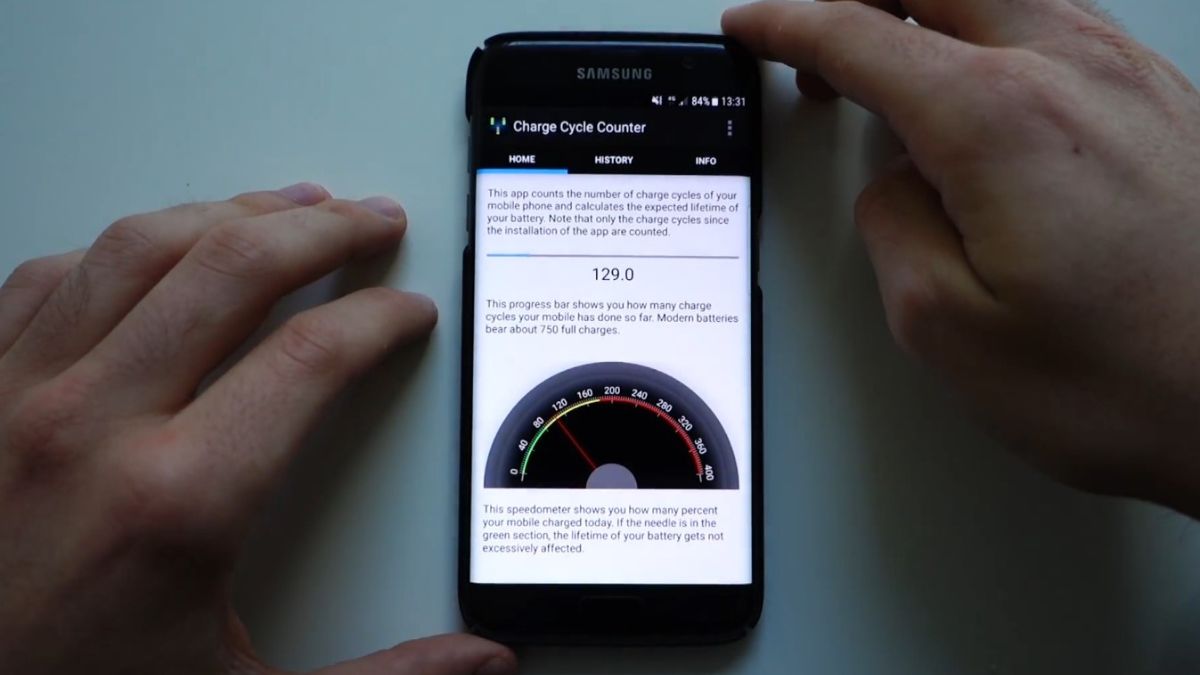
The battery determines more than ever the actual lifespan of a smartphone. Yet, the majority of users rely solely on the percentage displayed on the screen, never knowing what their battery has truly endured since the first startup. Android 14, however, includes an internal counter capable of indicating the exact number of battery cycles, without any external application, third-party tool, or risky intervention. This information exists, it is reliable, but it remains deliberately hidden within the system.
Each lithium-ion battery operates on a simple but little-known principle. A cycle corresponds to the equivalent of 100% of consumed capacity, regardless of the number of intermediate recharges. A smartphone charged by 40%, then 30%, then another 30% totals a complete cycle. Android 14 continuously records this total from the initial activation of the device.
Industrial figures show that a battery maintains a correct stability up to 450 to 500 cycles. Beyond that, the capacity begins to decrease progressively. Around 800 cycles, the actual capacity often drops below 75%, even if the device never clearly indicates it. This internal counter is much more reliable than the simple feeling of autonomy or the approximate estimates displayed by some interfaces.
Android 14 stores battery-related information in system logs accessible from internal menus. This data is not intended for the general public, but it is readable directly from the smartphone without installing any additional software. It is raw history used by the system to manage charging, discharging, and thermal protection.
Depending on the manufacturers, this counter can be retained even after a major update. On some models, it also survives a partial reset. This means that the displayed number truly reflects the overall wear since the first use, not a recent estimate. This precision explains why manufacturers remain discreet about its access.
When autonomy begins to decrease, Android 14 does not display any clear warning. The smartphone continues to function normally, even if the battery has already lost a significant portion of its capacity. The number of cycles then becomes the most reliable indicator to understand this gradual decline.
For example, a smartphone displaying 650 cycles has already surpassed the threshold where capacity starts to drop more rapidly. At this stage, a loss of 15 to 20% is common, even if the charge still reaches 100%. Without consulting this counter, the user often attributes this decline to an update or a power-hungry application, when it simply results from the normal wear of the cells.
Knowing the number of cycles allows anticipating the battery’s evolution without waiting for visible degradation. A smartphone under 400 cycles generally retains autonomy close to its original state. Between 500 and 700 cycles, the decline becomes more noticeable, especially at the end of the day. Beyond that, the capacity continues to decrease, but more slowly and steadily.
On Android 14, this counter thus becomes a discreet but valuable diagnostic tool. It allows knowing if a decrease in autonomy is normal or if a battery replacement becomes relevant. Without an application, without complex manipulation, this simple number offers a much more realistic reading of the battery’s state than any percentage displayed on the screen.